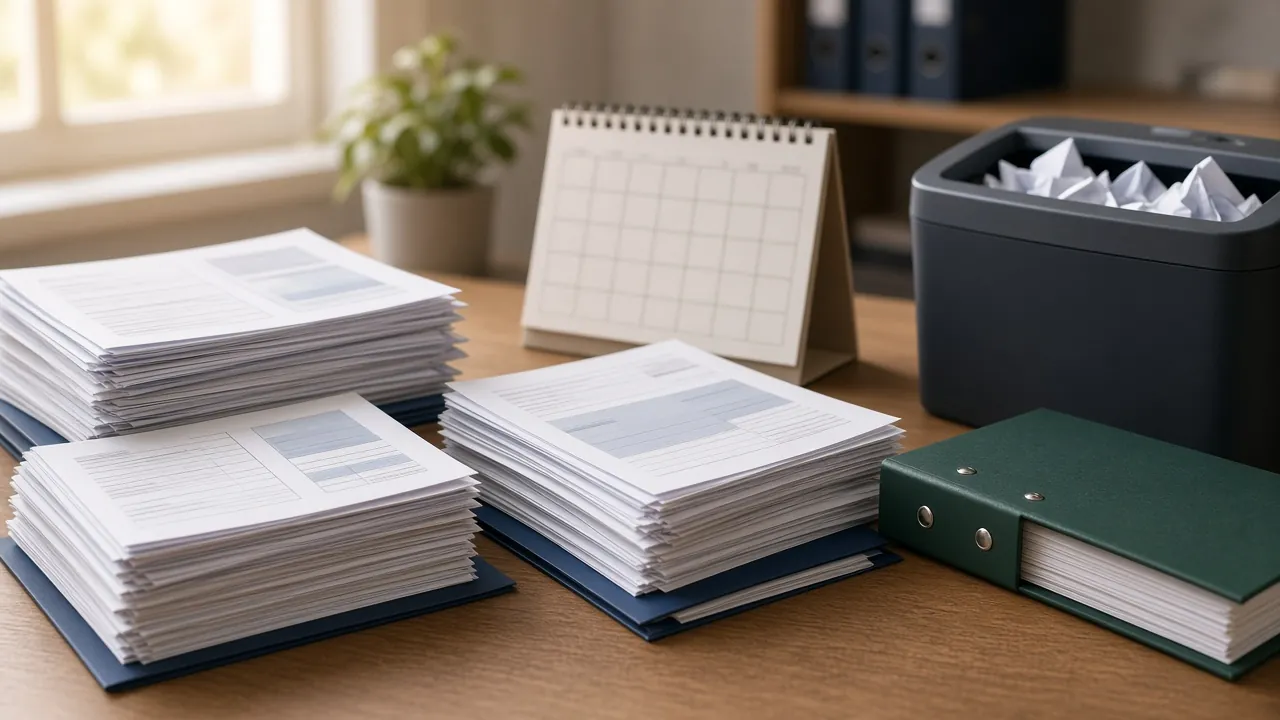
How Long to Keep Tax Records Before You Shred Them (What the IRS Actually Says)
Most people shred too early or never shred at all. One mistake can cost you supporting records during an IRS question. The other leaves years of account numbers sitting in a closet. The good news is that the IRS publishes plain rules. Here they are in one place, with a practical routine for deciding what to keep, scan or shred.
The rule behind every number: the “period of limitations”
The IRS says you should generally keep records that support an item of income, deduction or credit on your tax return until the period of limitations for that return runs out. The period of limitations is the window in which you can amend a return to claim a credit or refund, or in which the IRS can assess additional tax.
Two details from the IRS that people often miss:
- The years count from when the return was filed.
- A return filed before the due date is treated as filed on the due date. Filing early doesn’t start the clock early.
The IRS retention periods at a glance
| Your situation (per the IRS) | Keep records for |
|---|---|
| Standard case, none of the situations below | 3 years |
| You file a claim for credit or refund after filing your return | 3 years from filing the original return, or 2 years from paying the tax, whichever is later |
| You claim a loss from worthless securities or a bad debt deduction | 7 years |
| You don’t report income you should have, and it exceeds 25% of the gross income shown on the return | 6 years |
| You don’t file a return | Indefinitely |
| You file a fraudulent return | Indefinitely |
| Employment tax records (if you have employees) | At least 4 years after the tax becomes due or is paid, whichever is later |
Source: IRS, “How long should I keep records?”
The IRS also says to keep copies of your filed tax returns, because they help with future returns and with amended ones.
Property records follow a different clock
Records connected to property, such as a home, investments or rental property, are kept differently. The IRS says to keep them until the period of limitations expires for the year in which you dispose of the property. You need them to work out depreciation and your gain or loss when you sell.
In practice, records related to your home’s purchase price and improvements may need to be kept for as long as you own the home, plus the retention period for the year you sell it. The IRS adds that if you received property in a nontaxable exchange, you keep the records for the old property too, until the period expires for the year you dispose of the new one.
Before you shred: check non-tax reasons
The IRS makes a point worth repeating: once records are no longer needed for tax purposes, don’t discard them until you check whether you need them for other reasons. Its examples are insurance companies and creditors, which may require you to keep records longer than the IRS does. Loan paperwork, warranties, insurance policies and legal documents each have their own logic, so check with the institution involved.
A simple keep, scan or shred routine
Once a year (many people do it right after filing their taxes), sort your paper into three piles.
Keep the original, preferably in a fire-rated box
- Filed tax returns (the IRS recommends keeping copies)
- Records for property you still own, such as home purchase and improvement records
- Birth and marriage certificates, passports, Social Security cards, vehicle titles, deeds, wills
- Anything tied to a situation the IRS says requires longer retention
See our guide to the best fireproof safes for home documents and how to read fire safe ratings.
Scan, then decide
Supporting documents for recent returns, such as receipts, statements and 1099s, are good candidates for scanning. Scanning makes them searchable and easy to back up. Whether a scan is enough on its own depends on the document and on who might ask for it, so check before you shred originals of anything important. A sheet-fed scanner makes this fast (see our ScanSnap iX2500 vs iX1600 comparison).
Shred
When a record is past every retention period that applies and you have no non-tax reason to keep it, shred it rather than recycling it whole. Statements, old returns and pay stubs carry account numbers, Social Security numbers and income details. For these, a P-4 security level shredder is the sensible home standard: cross-cut or micro-cut particles no larger than 160 mm² under DIN 66399. Strip-cut shredders produce long strips that can be reassembled. Our shredder buying guide explains security levels and run time.
A worked example (illustrative only)
Suppose you filed your 2022 return on time and none of the special situations apply. The standard period is 3 years from the filing date, so the supporting receipts for that return would generally pass the IRS’s 3-year mark in spring 2026. Before shredding them, you would:
- Confirm none of the longer periods apply, such as a worthless-securities claim (7 years) or unreported income (6 years).
- Pull out anything related to property you still own, and keep it.
- Keep a copy of the filed return itself.
- Check whether an insurer, lender or other party needs any of it.
Only then would the remaining paper go to the shredder.
Bottom line
The IRS baseline is 3 years, with longer periods for specific situations: 4 years for employment tax records, 6 for substantially unreported income, 7 for worthless securities or bad debts, and indefinitely if no return or a fraudulent return was filed. Property records run until the period ends for the year you dispose of the property. Keep copies of filed returns, check non-tax reasons before discarding, and shred what you no longer need at P-4 or better.
Source: Internal Revenue Service, “How long should I keep records?” (irs.gov), accessed November 9, 2026. DIN 66399 particle limits as summarised in our shredder buying guide. This article is general information, not tax advice.